International Economic Gardening & Entrepreneurial-led

The Oman Business Forum, in partnership with the Ministry of Commerce, Industry and Investment Promotion (MoCIIP), hosted a session on Economic Gardening on April 30, 2024.

The event was part of the Tejarah Talks series and it occurred at the Oman Convention and Exhibition Centre (OCEC) in Muscat, Oman. The session was titled “Economic Gardening: Nurturing & Cultivating Second Stage Companies."

This discussion focused on strategies to support the growth of second-stage companies, emphasizing job creation and sustainable economic development. It highlighted the importance of providing these businesses with essential resources, such as strategic information and connections, and discussed the role of supportive public policies in nurturing their development.

For details about the event, visit the Oman Business Forum website.

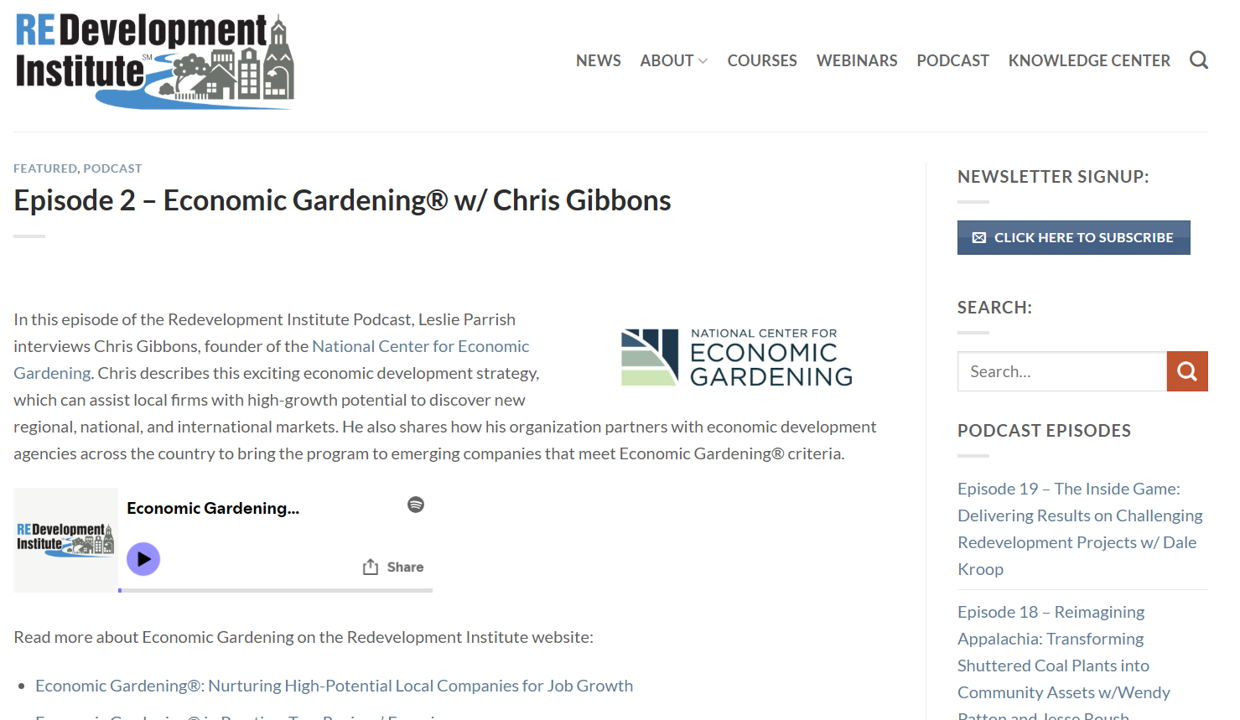
Redevelopment Institute Podcast explores NCEG – Leslie Parrish

In the Redevelopment Trailblazers podcast, National Center for Economic Gardening founder Chris Gibbons explains how communities can build sustainable wealth by supporting "Stage 2" companies—locally grown firms with 10–100 employees and up to $50 million in revenue. Unlike traditional economic development that focuses on recruiting outside corporations, Economic Gardening provides high-growth local businesses with the sophisticated strategic tools usually reserved for the Fortune 500, such as market research, competitor intelligence, and GIS lifestyle mapping.

Gibbons shares several success stories illustrating the program's versatility, from a small-town Kansas porch banner maker who used neighborhood-level data to scale her workforce, to a West Virginia software firm that identified new markets for trucking scales through Department of Transportation records. For agencies interested in boosting their local economy, Gibbons recommends starting with a five-company pilot project. This "toe-in-the-water" approach allows leaders to see tangible results and CEO feedback before committing to a full-scale program.

Click below to visit Redevelopment Institute 

Redevelopment Institute Podcast Page

Redevelopment Institute

Economic Gardening Featured in Inc. Magazine

For economic developers, Inc. magazine’s “What Is Economic Gardening?” is a timely reminder that chasing relocations with incentives can easily become a race to the bottom, while entrepreneurship‑led Economic Gardening quietly delivers more jobs at a far lower cost per job.

Inc. magazine published a feature on Economic Gardening that began with how communities can grow jobs by supporting existing businesses instead of chasing relocations.

The April 2025 article revisits Littleton, Colorado’s response to major layoffs in the 1980s and explains how Economic Gardening equips second‑stage companies with advanced research tools—market and GIS mapping, competitive intelligence, SEO analysis, and trend data—to help them find new customers and scale.

Inc. notes that Economic Gardening creates new jobs at a much lower cost per job than traditional recruitment deals, making it an attractive option for entrepreneurship‑led economic development practitioners looking to maximize impact with limited resources.

For regions embracing entrepreneurship‑led economic development, three points from the article stand out.

First, Economic Gardening keeps the focus on local stage two companies that already generate a disproportionate share of new jobs and income in every state, rather than attempting to “buy” growth from outside.

Second, programs built on Economic Gardening principles routinely report cost‑per‑job figures in the neighborhood of 1,500–2,000 dollars, versus 20,000–250,000 dollars per job for many incentive‑driven recruitment packages.

Third, Littleton’s long‑term results—doubling its job base from roughly 15,000 to 30,000 and growing sales tax revenue from about 6 million to 20 million dollars without recruiting a single company or offering incentives—demonstrate that this approach is durable over decades, not just a short‑term pilot.

Inc.’s coverage underscores what practitioners have been seeing on the ground for years: entrepreneurship‑led Economic Gardening has moved into the mainstream as a core pillar of modern economic development strategy, not a niche experiment. As the national center that helped develop and scale this model, the National Center for Economic Gardening (NCEG) partners with regions to implement high‑fidelity Economic Gardening programs that deliver measurable job growth, stronger local firms, and a more resilient tax base.

Read "What Is Economic Gardening?" on Inc.com →

The Economic Gardening Book; History of EG – Available for download!

“Economic Gardening” is a book that covers the history and background of the original “grow your own” economic development program in Littleton, Colorado.  The book also include chapters on the program as it is run today by the National Center for Economic Gardening, as well as a complete listing of the principles, tools and analytical techniques used in high fidelity programs.  Part II of the book is called “An Amateur’s Observations on the Economy” and includes a collection of unusual insights into the economy derived from 30 years of work in Economic Gardening.

To download the book in PDF format please visit this page.

The Rise of the Entrepreneurial Era: How Economic Development is Changing

What does it take to change how an entire profession thinks about economic growth? Work with existing companies and with an entrepreneurship-led strategy

In 1987, Littleton, Colorado responded to a 7,000‑job layoff by formally committing to “work with local entrepreneurs to create good jobs,” launching what became the first Economic Gardening program in the United States.

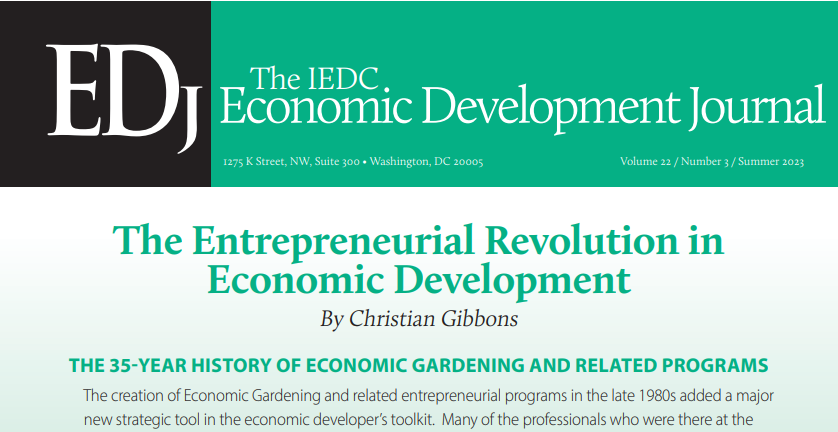
In the article “The Entrepreneurial Revolution in Economic Development,” published originally in the International Economic Development Council’s Economic Development Journal (Summer 2023, Vol. 22, No. 3), NCEG founder Chris Gibbons documents how that decision evolved into a structured approach that focuses on Stage 2 growth companies, applies market research and GIS tools, and helps locally based firms reach external markets.

inclusion in the IEDC’s journal situates Economic Gardening in the mainstream of current practice, alongside other strategies EDCs use. For practitioners, the article offers a concrete example of how an entrepreneurial, information‑driven program can complement traditional business recruitment within a broader economic development portfolio.

You can download the full article directly from NCEG here: Download PDF now

Members can also access it via the IEDC Economic Development Journal website: Visit IEDC’s Economic Development Journal website. 

Article published IEDC Economic Development Journal (Volume 22, Number 3, Summer 2023). Reposted with permission.